Bidding Wars Are Back in Housing Market Stung by Pandemic
Michael Jordan Faced Better Competition Than LeBron James
The World’s Greatest Coach Is Not Who You Think
A coming bio revolution is poised to change the world
The Work-From-Home Trader Who Shook Global Markets
Solar’s Future is Insanely Cheap
Doctors keep discovering new ways the coronavirus attacks the body
The Confessions of Marcus Hutchins, the Hacker Who Saved the Internet
Doctors are now social-media influencers. They aren’t all ready for it.
Because of my current role I have been asked several times to think “strategically” , to develop a strategic plan, or asked to explain how a transformation plan fit in the overall strategy of the company.
Reading these articles , about the tendency of companies not doing hard enough work in developing and stating in a clear and concise way their strategy made me understand that it is a very frequent challenge: What is Strategy? How does strategy forms withing a company? Who defines strategy?
Trying to better understand all those questions I decided to find what are the best references. As both articles state, there are hundreds of books but I decided to start with this book.
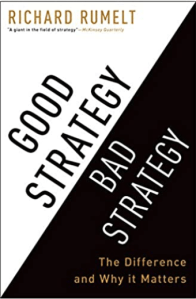
I guess I liked it because it treats the subject in general guidelines rather than being a prescriptive, “fill in the blanks” strategy book (which is just what the author refers to as an example of “bad strategy”).
The book is divided in three sections:
I will try to summarize those ideas in this blog post.
The concept of bad strategy was first discussed by the author in a seminar of the “The Center for Strategic and Budget Assessments (CSBA)” to study the Decline in the quality of Strategy work at the national level . The full study is available on line, I highly recommend reading it: It’s 68 pages long, and mostly about US National Security Strategy but I think is worth the time, to gain insight in how to outline a Strategic Analysis outside of a business context.
According to the book bad strategy is above all the tendency to avoid analyzing in depth the current external trends, and the current internal situation of your company to define what the current challenge is. It is also a lack of focus and the inability to make hard choices as to where to focus the limited resources of a company . How to recognize it?
The author provides some guidelines:
Fluff: Fluff is a form of gibberish masquerading as strategic concepts or arguments. It uses “Sunday” words and apparently esoteric concepts to create the illusion of high level thinking
Failure to face the challenge: Bad Strategy fails to recognize or define the challenge. When you cannot define the challenge, you cannot evaluate a strategy or improve it.
Mistaking goals for strategy: Many bad strategies are just statements of desire rather than plans for overcoming obstacles.
Bad strategic objectives: A strategic objective is set by a leader as means to and end. Strategic objectives are “bad” when they fail to address critical issues or when they are impracticable.
As a consequence companies end up with a list of disparate generic goals:
Leaders may create bad strategy by mistakenly treating strategy work as an exercise in goal-setting rather than problem solving. Or they may avoid hard choices because they do not wish to offend anyone”
Bad strategy “is not the same thing as no strategy or strategy that fails rather than succeeds”. A lot of emphasis is made in different sections of the book to the challenges companies face in making decisions that prioritize resources. Anyone working in defining and implementing transformation plans as a part of a strategic plan would be familiar with this paragraph:
…The unwillingness or inability to choose. Strategies focus resources, energy, and attention on some objectives rather than others. Unless collective ruin is imminent, a change in strategy will make some people worse off. Hence, there will be powerful forces opposed to almost any change in strategy. This is the fate of many strategic initiatives in large organizations. There may be talk about focusing on this or pushing on that, but at the end of the day no one wants to change what they are doing very much.
Additionally the author tries to make clear, that some things that are considered or labeled as “strategic” not necessarily are part of strategy in a wider sense.
In business, most M&A, investments in expensive new facilities, negotiations with suppliers and customers and organizational design are normally considered “strategic”. Rather the term “strategy” should mean a cohesive response to an important challenge.
In essence, strategy is about analyzing , about discovering and designing:
The core of Strategy work is always the same: Discovering the critical factors in a situation and designing a way of coordinating and focusing actions to deal with those factors
To avoid abstract and generic definitions, emphasis must be made that a good strategy must include a set of actions to follow.
But defining strategy as a broad concept, living out action, creates a wide chasm between “strategy” and “implementation”.A good strategy includes a set of coherent actions. A strategy that fails to define a variety of plausible and feasible immediate actions is missing a critical component.
Since bad strategy is so common, there is a natural advantage in at least trying to develop a good strategy.
The first natural advantage of good strategy arises because other organizations often don’t have one. And because they don’t expect you to have one either.
A recurrent theme in the book is the relevance of concentrating resources when defining and executing Strategy:
Most complex organization’s spread rather than concentrate resources, acting to placate and pay off internal and external interest. Thus, we are surprised when a complex organization such as Apple or the US Army actually focuses its actions. Not because of secrecy but because good strategy itself is unexpected.
Despite these most organizations will not create focused strategies instead they will generate laundry list of desirable outcomes and, at the same time, ignore the need for genuine competence in coordinating and focusing their resources. Good strategy requires leaders who are willing and able to say no to a wide variety of actions and interests. Strategy is at least as much about what an organization does not do as it is about what it does.
As in a lot of aspects of management there is no silver bullet, every company is different, each industry has its own challenges so the book tries to avoid giving specific solutions but it gives general guidance as to what is the very minimum a good strategy must have. The author calls this The Kernel:
Good strategy is coherent action backed up by an argument, an effective mixture of thought and action with a basic underlying structure I call the Kernel. A good strategy may consist of more than the Kernel, but if the kernel is absent or misshappen then there is a serious problem.
The Kernel of a Strategy contains three elements:
- A diagnosis that defines or explains the nature of the challenge. A good diagnosis simplifies the often overwhelming complexity of reality by identifying certain aspects of the situation as critical.
- A guiding policy for dealing with the challenge. This is an overall approach chosen to cope with or overcome the obstacles identified in the diagnosis.
- A set of coherent actions that are designed to carry out the guiding policy. These are steps that are coordinated with one another to work together in accomplishing the guiding policy.
In “Good Strategy” a key element is finding the critical aspects that make a difference and concentrating resources to try to make a difference, those critical aspects are referred in the book as sources of power. What are those fundamental sources?
There are extensive examples and frameworks in Strategy literature , but the author highlights in the book just a few of them (……”chosen for both their generality and freshness”)
A brief Summary (the rest of this section is mostly quoted directly from the book):
The last section gives some advice about how to improve and gain proficiency when working with Strategy Development. I liked the idea analogy of treating Strategy as a hypothesis, An educated prediction of how the world works.
A good business strategy deals with the edge between the known and the unknown. Again, it is competition with others that pushes us to edges of knowledge.
Given that we are working on the edge, asking for a strategy that is guaranteed to work is like asking a scientist for a hypothesis that is guaranteed to be true -it is a dumb request.
A good strategy is, in the end, a hypothesis about what will work. Not a wild theory, but an educated judgment. An educated prediction of how the world works. Good Strategy work is necessarily empirical and pragmatic.
Science is a method, not an outcome, and the basic method of good business people is intense attention to data and to what works.
In the last years the role of cognitive bias in decision making has become very relevant. The author also recognizes this fact and suggest that a good strategist should try to improve its “own cognitive limitations and biases” .
Today, we are offered a bewildering variety of tools and concepts to aid in analysis and the construction of strategies. Each of these tools envisions the challenge slightly differently. For some it is recognizing advantage; for others it is understanding industry structure. For some it is identifying important trends; for others it is erecting barriers to imitation. Yet there is a more fundamental challenge common to all contexts. That is the challenge of working around one’s own cognitive limitations and biases – one’s own myopia. Our own myopia is the obstacle common to all strategic situations.
Being strategic is being less myopic – less shortsighted – than others. You must perceive and take into account what others do not, be they colleagues or rivals. Being less myopic is not the same as pretending you can see the future. You must work with the facts on the ground, not the vague outlines of the distant future. Whether it is insight into industry structures and trends, anticipating the actions and reactions of competitors, insight into your own competencies and resources, or stretching your own thinking to cover more of the bases and resist your own biases, being “strategic” largely means being less myopic than your undeliberative self.
Finally the author gives some broad advice to guide your own thinking.
In strategy work, knowledge is necessary but not sufficient. There are many people with deep knowledge or experience who are poor at strategy. To guide your own thinking in strategy work, you must cultivate three essential skills or habits. First, you must have a variety of tools for fighting your own myopia and for guiding your attention. Second, you must develop the ability to question your own judgment. If your reasoning cannot withstand a vigorous attack, your strategy cannot be expected to stand in the face of real competition. Third, you must cultivate the habit of making and recording judgments so that you can improve.
This las point (recording judgments in order to evaluate and improve) is also suggested as one of the methods to improve the decision making process in Thinking in Bets.
So, What is Strategy? How does strategy forms within a company?, Who defines strategy? No doubt it is a broad , complex and fascinating subject. Surely there is a lot more to learn than what is covered in this book, but it is definitively a good starting point and I highly recommend reading this book.
I found particularly interesting the following topics/insights:
Finally, here is a list of references I found very concise and insightful, not all of them are available for free on line but if you can get them, I am sure you will find them useful too:
Henry Mitzberg on How Strategy Emerges, The Role of Design in Strategy and How Strategy can emerge Bottom Up rather than Top Down:
Patterns of Strategy Formulation
Of Strategies, Deliberate and Emergent
Fall and Rise of Strategic Planning
The role of the Strategy Officer and the creation of the Office of Strategy Management:
Robert S. Kaplan and David P. Norton , The Office of Strategy Management
Creating the Office of Strategy Management
Michael Porter Five Forces and Competitive Advantage:
Michael Porter – What is Strategy and Andrea Ovans – What is Strategy, Again
This is a long overdue experiment to start writing again. I own this domain since about 2005, I bought it that year and started a website (mostly technical things and programming) . Although it never really gained much track and I stopped both , writing and paying for the hosting service , it helped me to experiment and proved to be a very good way to make new contacts from around the world , so I kept this domain name hoping to give it a better use in the future.
I keep reading quite frequently from a lot of people I admire that the best way to develop new relations and profesional contacts is start writing, but where to start?
It is not something I speak frequently of but I read a fairly amount of books, but I have noticed I find hard to remember the main aspects or insights of the books I read. So I guess a good way to start writing is to try to post/write in this blog reviews of the books I read. It will be my personal way to recall the main aspects and I guess it would also be an attempt to become a better reader.
I will also try to post also what I find interesting to share….let’s see how this plays out , the major challenge will be to develop the discipline to do it on a frequently basis.
 Mario Alberto